

Introduction
There is a particular kind of loss that arrives without announcement. It does not break anything. It does not leave a mark that can be pointed to, documented, grieved in the conventional sense. It is the loss of the threshold, the slow, administered disappearance of the world a child inhabits before the adult world decides she is ready to enter its own. We do not have a good name for this loss because we have, collectively, agreed not to look at it directly. We call it growing up. We call it maturity. We call it the natural order of things, and in calling it natural we absolve ourselves of the question that sits underneath every panel of this series. Who decided this was what she was supposed to become?
The nine images that constitute this body of work refuse that absolution. They place the question back in the room and hold it there, across nine frames, without flinching and without resolution. They do not offer the comfort of a villain. There is no single moment of rupture, no identifiable agent of harm, no raised voice, no obvious wound. What they offer instead is something harder to sit with, the portrait of a process so ordinary, so embedded in the textures of daily life and love and cultural normalcy, that it can only be recognized in retrospect, if at all. By the time the girl in these images arrives at the end of her journey through them, she has already forgotten what the beginning felt like. That forgetting is not incidental. It is the point.
The word that organizes this essay is grammar. It is chosen deliberately and it is meant to carry its full weight. Grammar is not an event. It is not a rupture or a revelation or a single transformative moment. It is a system, assembled incrementally, absorbed long before it is understood, operative in the body and the hands and the way one moves through space before the speaker ever becomes conscious of speaking. Children learn grammar without being taught it in any direct sense. They are immersed in it. It enters them through repetition, through exposure, through the thousand small acts of daily life that constitute an education no curriculum ever names. What this series proposes, and what this essay will argue across three acts, is that the loss of innocence functions in exactly this way. It is not a theft. It is an education. And like all education, it begins with what the child is given to hold.
The toy precedes the gun not as its opposite but as its introduction. This is the central proposition of the work, and it is worth sitting with before the panels themselves are examined. We are accustomed to thinking of childhood play as the domain of freedom, unstructured, consequence-free, belonging entirely to the child who inhabits it. Johan Huizinga, in his foundational account of play, described it as a voluntary activity, one that stands outside ordinary life, operating within its own boundaries of time and space (Huizinga 28). But Huizinga also understood that play is never truly outside culture. It is the space in which culture does some of its most efficient work, transmitting values, rehearsing roles, encoding the rules of the world under the cover of freedom and joy. What the child believes she is choosing freely; the world has already prepared for her. What she believes she is discovering, the world has already decided she will find. The toy is not given innocently. It is the first argument the world makes about who she is and what she is for, and it is made gently enough, lovingly enough, that it feels like nothing more than a gift.
This is what makes the grammar so difficult to name and so difficult to refuse. It does not announce itself as instruction. It announces itself as love. The people who hand the girl her first object, who shape her first games, who define the boundaries of her first world, they are not, in most cases, conscious agents of harm. They are themselves fluent in a grammar they never chose, passing on what was passed to them, in the only language they know. The violence that this series documents is not the violence of individual malice. It is the violence of structure, slower, quieter, more total, and far more difficult to resist precisely because it wears the face of the ordinary.
Roger Caillois introduced a distinction that is useful here. He separated play into two poles. The first is paidia, the spontaneous, unregulated, exuberant freedom of pure play. The second is ludus, the rule-bound, structured, socially regulated form that play takes when it is organized by adult culture (Caillois 13). The nine panels of this series can be read as a movement along that axis, from the paidia of the first act, where the girl plays in the full sovereignty of her own body, to the ludus of the final act, where the rules have been fully internalized and the game has become indistinguishable from life. The tragedy is not that she loses her freedom in any obvious sense. The tragedy is that by the time the rules are complete, she experiences them as freedom. She has been so thoroughly educated into the grammar that she no longer notices she is speaking it.
It is this, the moment of full fluency, of naturalization, of the taught becoming the felt, that the nine panels are building toward. Each image is a lesson. Each act is a term in an education that the girl did not enroll in and cannot withdraw from. What this essay will trace, across the three acts of the series, is the precise shape of that education, the objects, the gestures, the gazes, the silences, the hands and what they are asked to carry, so that by the end, when the final panel arrives, the viewer understands not just what the girl has become but how completely, how quietly, and how tenderly the world conspired to make her into it.
Playtime is over. It was over before she knew it had begun.
Act I The Offering
The first act belongs to the world before. These three panels establish the girl in the full, unguarded sovereignty of childhood, before the crossing, before the weight of what comes next has entered the frame. But the act does not offer this world without complication. From the very first image, the sacred and the cultural are already in conversation, already conspiring around a girl who does not know she is at the center of anything. What she is given here is a toy. What the giving means is something else entirely. The first act of this series understands that the loss of innocence does not begin with the real thing. It begins with the rehearsal of it, with the small object placed in open hands, with the gesture learned so early and so gently that by the time the stakes arrive, the hands already know exactly what to do.
The Gift
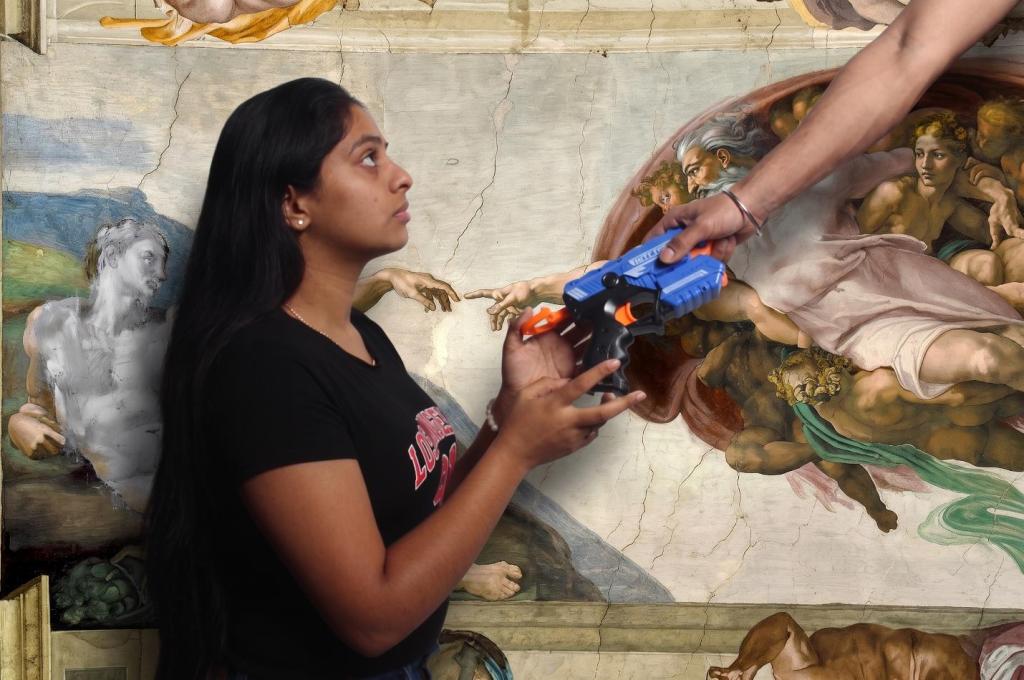
The opening panel places the series’ entire argument in a single frame. Behind the girl spreads Michelangelo’s The Creation of Adam, the central image from the Sistine Chapel 1512. In it the hand of God reaches across and toward the hand of Adam. Their fingers are almost touching. The whole weight of divine intention is suspended in that gap. It is the image Western civilization has chosen, above almost any other, to represent the moment a life is given its meaning. And in the foreground of this panel, directly beneath it, echoing it in a gesture, a toy gun is being received. The hand positioning is almost identical. One hand extended in offering, one hand reaching to receive, the object passing between them in the same suspended, almost-touching geometry that the Sistine Chapel made eternal.
The gun, even in its toy form, even here at the very beginning of the series, is not simply an object. It is the central metaphor of everything that follows, the embodied sign of what innocence looks like in the moment before it begins to leave. The mural does not comment on the exchange happening beneath it. It simply frames it, and in framing it, consecrates it. That the gun is a toy does not soften the image. If anything it sharpens it, because what is being consecrated here is not the weapon but the gesture, the open hands, the willingness to receive, the posture of acceptance that the real gun will one day simply complete. And crucially, the hand that offers is not a stranger’s hand. It belongs to someone inside her world, someone she trusts, which means what this panel also quietly establishes is that the loss of innocence is never administered from the outside. It is passed down from within, person to person, generation to generation, the same gesture repeated across time, the same object placed in the same open hands, the cycle continuing long before the girl was born and long after this particular moment of receiving is over. This is how innocence is first opened, not by force, not by a single violent act, but by a small, ordinary object passed between hands beneath the gaze of something eternal, in the language of gift, with absolutely no acknowledgement that the receiving was never truly a choice.
The Arrival
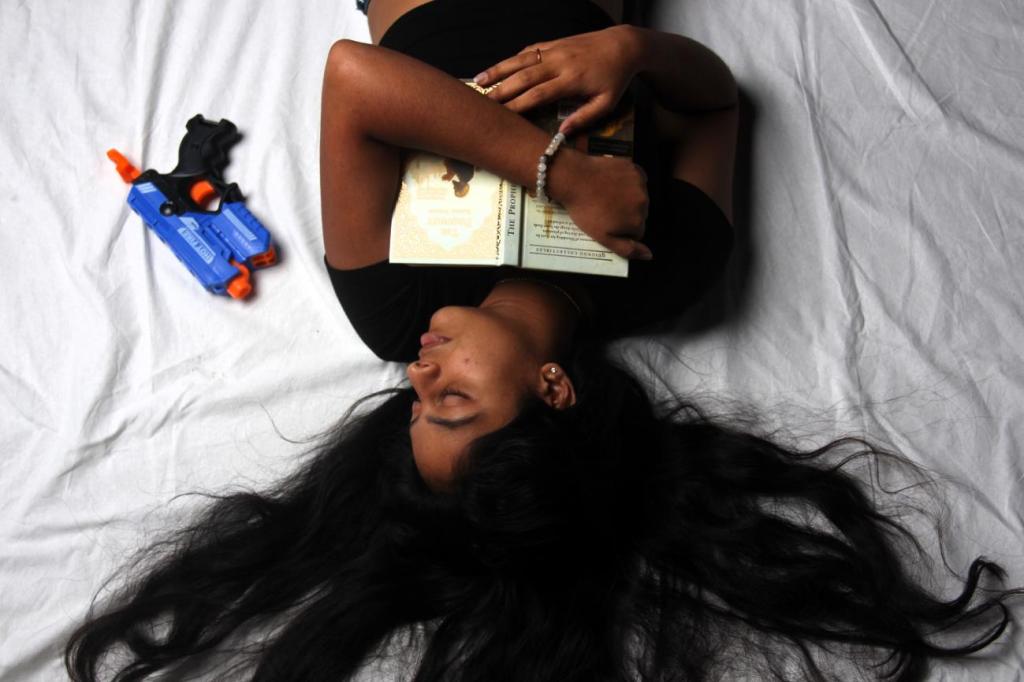
The girl holds the book against her chest with both arms crossed over it. It is clutched, claimed, pulled close in the way a person holds something they already know belongs to them. The gun sits on the white sheet beside her, untouched and unclaimed. She has not ignored it. Ignoring requires awareness. She simply has not reached it yet. This is the panel that establishes what the series understands innocence to actually be. Not purity, not the absence of the world, but the condition of not yet having been asked to choose. The first panel showed the gesture of receiving being consecrated, the cycle beginning, the grammar being written into her hands before she had any say in it. This panel shows the moment before that grammar has reached her interior life. The book is already hers in a way the loss is not. She has crossed her arms over one and left the other lying beside her, and that difference in holding is the distance between what she has chosen and what she has not yet been asked to reckon with. What sits beside her is not simply a toy. It is the shape that lost innocence takes before it is recognized as such. Innocence does not know what it stands to lose, and that is precisely what this panel is showing. She holds the book. The other thing waits. The grammar that
the first panel consecrated has entered her world but has not yet entered her. That gap, between what is already present and what is not yet felt, is where this panel lives.
The Familiarization
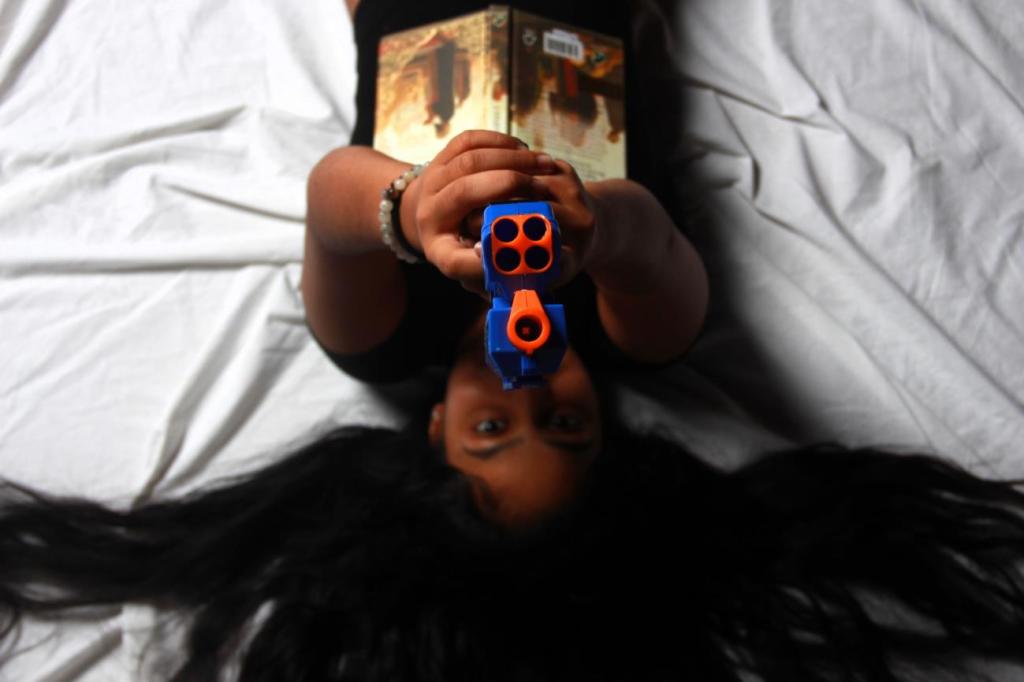
Between the second panel and this one, something happened that the series does not show. She put the book down and picked the gun up. There is no record of the moment of decision because there was no moment of decision. That is the point. The gun moved from beside her to in her hands with the same ease that any object moves when a child simply reaches for the next thing. She is playing. The muzzle is pointed directly upward and the book is still there, resting beneath her forearms, present but no longer primary. She has not abandoned it. She has simply found something else to do with her hands. This is what the acceptance of the grammar looks like from the inside. Not a crossing, not a transformation, not a moment she will remember. Just a girl on a white sheet doing what children do with objects once those objects have stopped being unfamiliar. The gun is hers now in the way the book was hers in the previous panel, claimed not through any conscious act of choosing but through the ordinary, unremarkable process of picking something up and finding that it fits. She is only having fun.
Conclusion
This is where Act One ends. She has moved from stranger to owner in three shots and without ceremony: no threshold crossed, no visible resistance overcome, no moment the series can point to and say here, this is when it happened. The familiarity accumulated the way familiarity always does, gradually and then completely, and by the time it was done there was nothing left to mark. That is the whole problem.
Act II The Descent
Introduction
She has changed. Not in any way the series announces, but the change is there, sitting on the surface, visible in the way she now occupies the frame. Something that was negotiation has become intention. She is not finding her way in anymore. She is already in, and what that means is only beginning to become clear.
Eden’s Playground
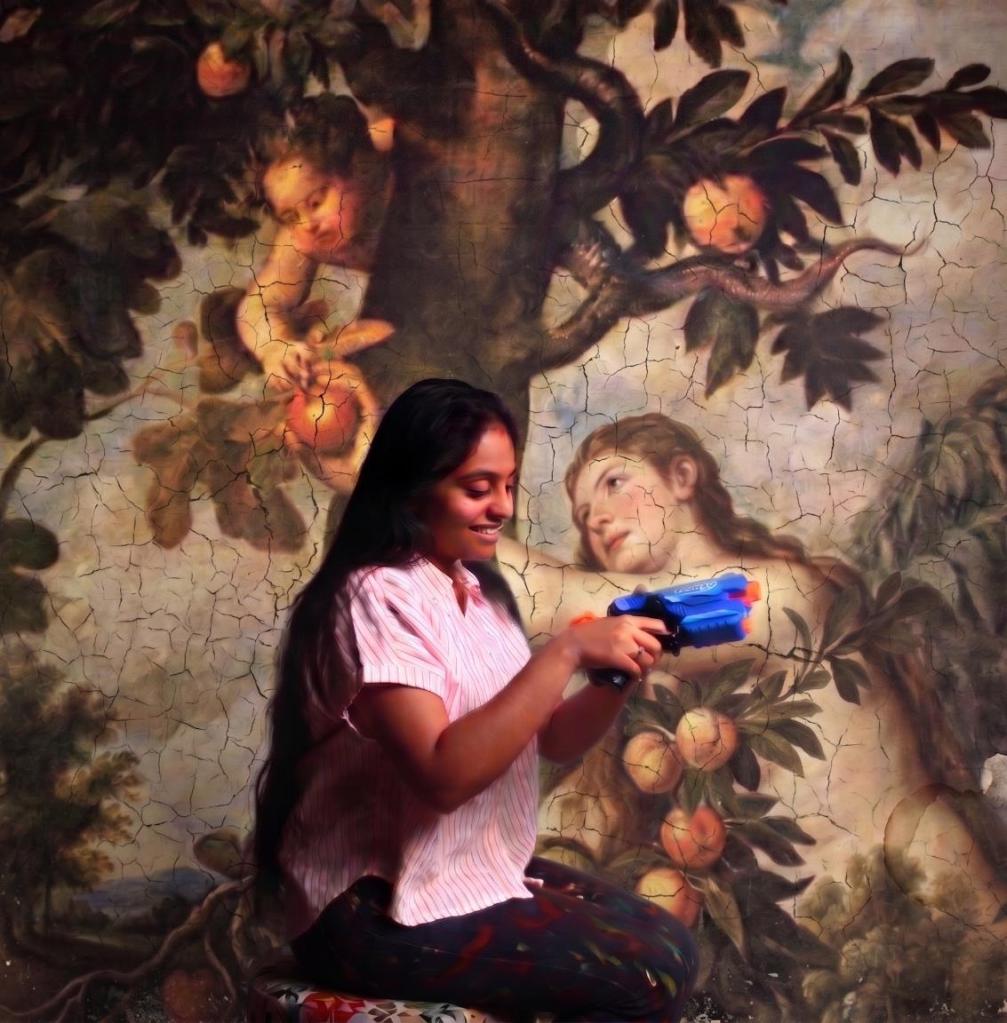
She is more composed now, more deliberate in how she presents herself. The casualness of Act One is replaced by something more considered, the kind of clothing that is less about comfort and more about belonging, about fitting the shape of a world she has decided to enter. The series does not make a fuss of it. It is just there, visible, the external surface of an internal process already well underway.
She is sitting with the gun in both hands and she is smiling at it. Not at the camera, not at anything in the room, at the gun itself. The handling is loose and easy, wrists relaxed, no friction left in the grip. This is what the complete absorption of a thing looks like. The gun moves through her hands the way a familiar thing moves, without thought, without distance between the object and the self holding it. She does not notice she is holding it. That is the point. Behind her, in Titian’s The Fall of Man, Eve is reaching for the fruit. Fingers extended, face open, entirely sincere in her wanting. She does not know what she is doing. That is also the point. Titian does not paint Eve as a villain. He paints her as someone mid-gesture, desire moving through her body before knowledge has had the chance to arrive and name it. The wanting is innocent because she does not yet know what the wanting means. The gun is the fruit. The series places her in front of that painting not to comment on her but to complete the image. Two women, two objects, the same unguarded moment of a thing passing from the world into the self and the self not flinching, not pausing, not knowing enough yet to do either. Titian froze Eve at the threshold, fingers extended, desire wearing the face of innocence. The camera catches her there too, comfortable, unhurried, already mid-fall and still only feeling the pleasure of the reaching.
The Blind Rite
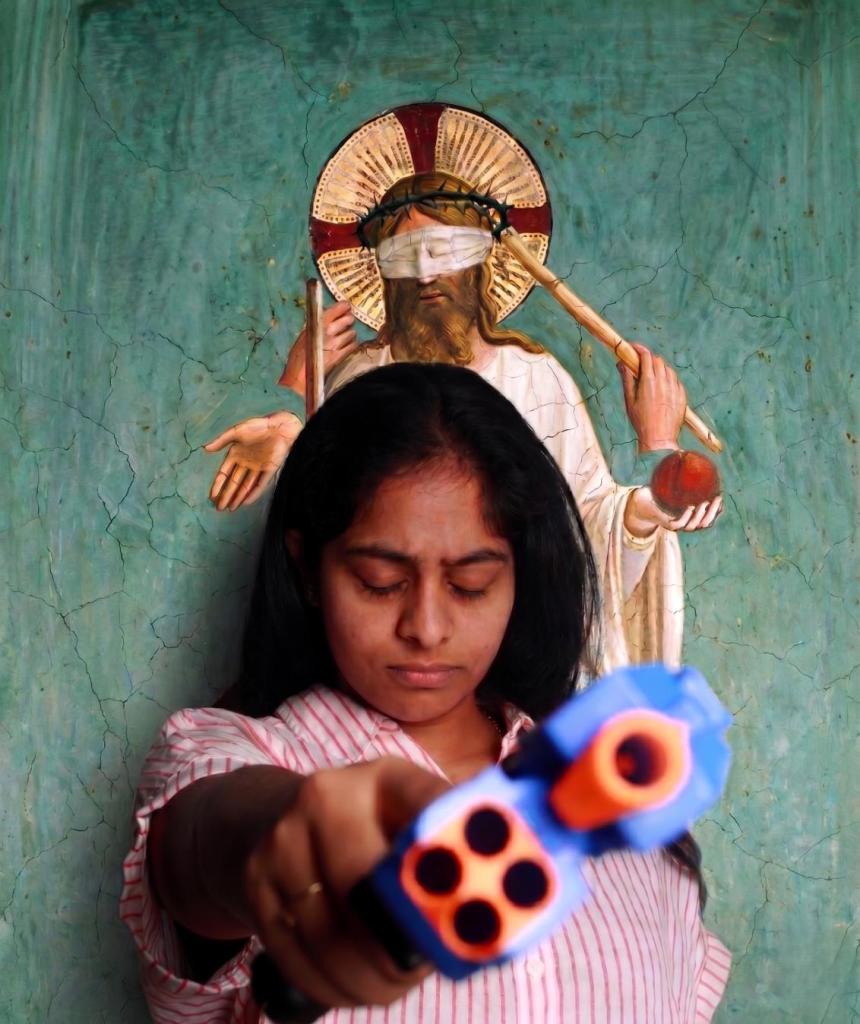
She is facing the camera directly with the gun extended forward in one hand, held diagonally, the grip loose and slightly off. The brow is tight, the jaw set, the face carrying the faint strain of something that requires effort. This is not the ease of Shot 4. The smile is gone. What replaced it is concentration, the expression of someone trying to mean something before they know how to mean it properly. The intention is completely there. The form is not. This is what the later stages of fitting in look like, not ease anymore but effort wearing the costume of ease, the self pushing toward a fluency it has not yet arrived at.
Behind her, centered on the wall, is Fra Angelico’s The Mocking of Christ. Christ sits blindfolded at the center while hands reach in from the edges of the frame to strike him. Fra Angelico makes a precise compositional choice: he paints only the hands. No bodies, no faces, no identities. The tormentors are rendered as pure anonymous force, sourceless and faceless, impossible to confront because there is no one there to confront. The blindfold is not incidental to what is happening to him. It is the condition that makes it possible. He cannot see the hands. That is the whole point. Her eyes are closed and the face tells you why. Not confidence, not mastery. The brow is tight, the expression caught somewhere between effort and discomfort, someone pushing through a threshold they have not fully decided to cross. She cannot fully face what she is doing so she does not face it at all. And that is the condition the painting already understands. Christ cannot see the hands coming because the blindfold was put there.
She cannot see them coming because she closed her eyes herself. Fra Angelico already knew this was how it worked. In the next shot, the hands will arrive, and they will have no faces either.
The Correction

The toy is gone. Not set down, not forgotten. Replaced, deliberately, by hands that knew exactly what they were doing and made sure she could not see them doing it. She is standing in darkness with the real gun placed into her hands by two sets of hands arriving from behind her, no bodies attached, no faces, no identities. The grip is corrected, the aim steadied, the exchange completed quietly and completely. In Act One she reached for the gun herself. She turned it over, claimed it, made it hers on her own terms. That was the version the series allowed her to believe was happening. This is the revision of that belief. She did not reach this time. It was given. The difference between those two things is the distance between innocence lost and innocence taken. The toy was the alibi. As long as it was plastic and bright and obviously harmless she could hold it, aim it, smile at it, close her eyes behind it, and none of it counted. The hands remove the alibi. What she has been doing this whole time now means exactly what it looks like. The fitting in, the outfit, the ease, the smile; the series reveals in this shot that none of it was hers. It was preparation. She was being made ready and the readiness has arrived. Fra Angelico painted Christ’s tormentors as hands only, no bodies, no faces, because the force that has no face cannot be confronted or refused. There is no one to push back against. It simply acts and leaves nothing to hold accountable. The hands behind her operate on the same logic. Her eyes were closed in the last shot. She chose that herself and they used it.
Her face is stiff, the fear settled and open, no longer the hesitation of Shot 5 but something that has finished arriving. The process that began with a girl on a white sheet reaching for a gun is complete. She is still holding it and the darkness around her holds nothing else.
Conclusion
Act Two never announces the moment things change. That is the point. The correction, the weight, the slow replacement of curiosity with compliance, none of it arrives as a single blow. It accumulates, shot by shot, until the girl who picked something up out of wonder is standing in a black void holding something she no longer needs to think about. The innocence did not leave. It was just gradually made irrelevant.
Act III The Void
Introduction
By Act Three, the fall is no longer happening. It has already happened, and the images are left to live in its aftermath. That matters because this act is not interested in repeating the descent or decorating it. It is interested in the state that follows, when the person at the center of the frame has already crossed a point she cannot cross back from. What remains is not motion but condition, not choice but the shape left behind by choices that have been made and absorbed. The toy, the metal, the dress, the void, the shift from outward aim to inward hold all begin to feel less like separate symbols and more like stages of the same surrender. By the time Act Three begins, the fall has already rewritten the subject, and the frame is only showing what that rewrite looks like when it has settled into silence.
The Mirror’s Paradox
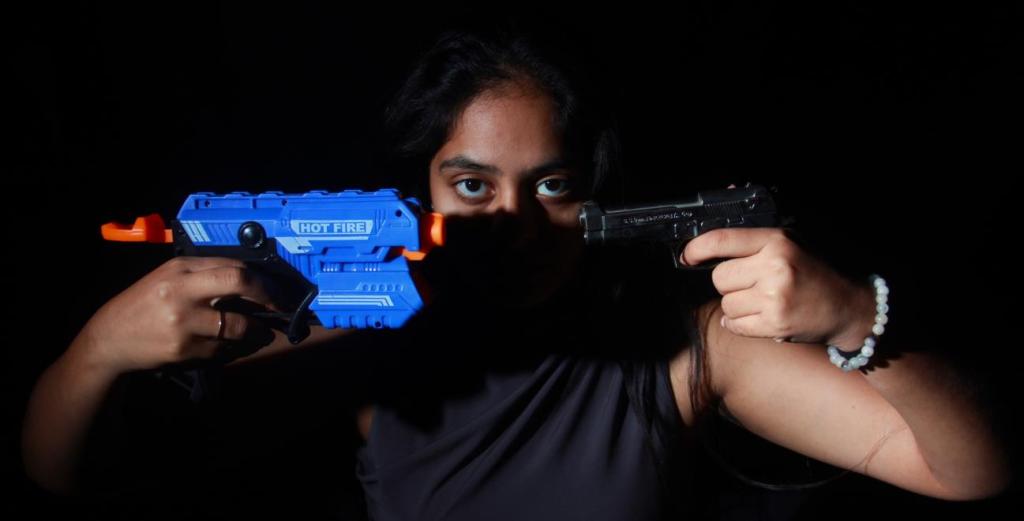
The series spent six shots treating the toy and the real gun as separate states. One came first, then the other, and the distance between them was where the story lived. Shot 7 closes that distance. Both guns are in her hands at the same time, muzzles pointed at each other, nearly touching, and everything the series built as a before and after folds into a single frame. She is not moving toward something anymore. She is standing inside the arrival.
The dress is the series quietly confirming that. The striped shirt belonged to the girl who was still in the process of becoming. That process is over. She has fitted in, absorbed the weight, worn it long enough that it sits on her like clothing, and the dark dress is the visual proof. The image is not asking whether she changed. It is asking what she is now, and it holds that question open by refusing to let either gun win. They face each other and neither yields. The toy does not disappear and the real gun does not absorb it. They are equal, held in the same hands, in the same breath.
The guns sit just below her eyes, slightly off center, and the shadow they cast falls across the lower half of her face like a veil. Her eyes are fully visible, clear and direct, but the nose, the mouth, everything that makes a face readable as someone feeling something, is swallowed into darkness. Composed above. Erased below. The two states held in the same face, neither resolving into the other. The blue is still bright, still the same object from the beginning, but the innocence it carried was never inside the object itself. It was in the distance between the two guns. And with almost none of that distance left, what she has become and what she was are now standing in the same breath, looking out through the same eyes, with nowhere left to separate them.
Point Blank
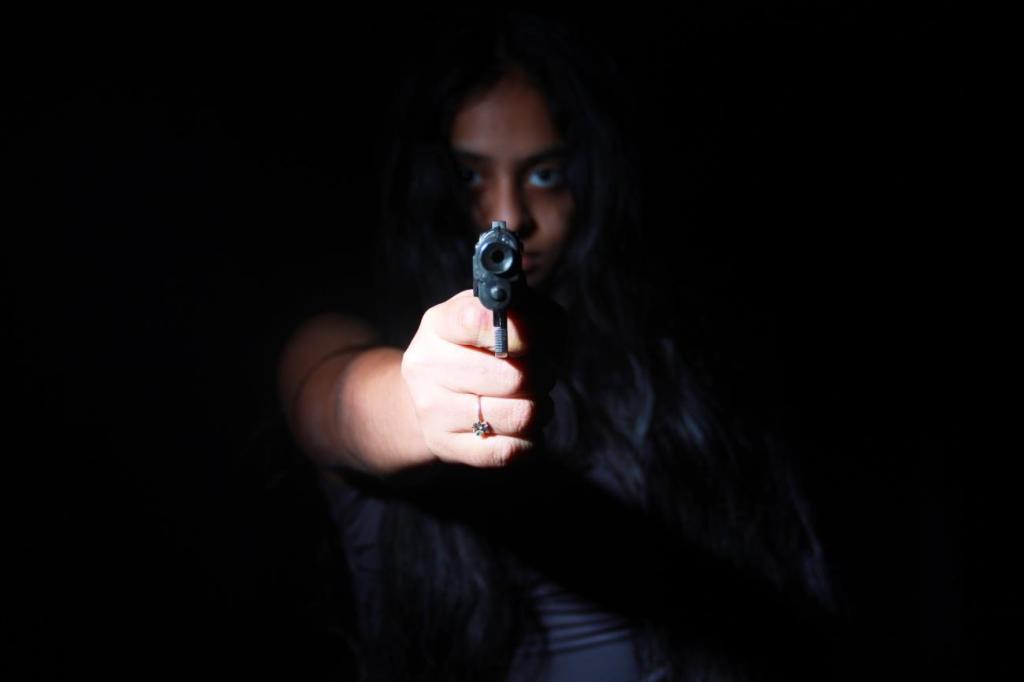
The toy is gone. There is only the real gun now, one hand, extended forward, muzzle pointed directly at the camera, and what that absence tells you is that the merger Shot 7 forced has already run its course. She did not need to choose. The choosing happened between frames, quietly, the way most irreversible things do. What Shot 6 introduced as correction she has now made her own. Nobody is adjusting her here. She self-corrects, extends the gun forward, and the confidence in that is not performed. It is the natural posture of someone who has stopped noticing the weight. That is what this shot is really marking, not a decision, not a moment of transformation, but the point at which the unfamiliar has become default. The learning is over. What you are looking at is fluency. Her eyes sit steady behind the sights, not with anger, not with grief, but with the calm of someone who has fully arrived. She has moved through curiosity, through fear, through the slow work of fitting in, and what is left on the other side of all of that is simply a woman who knows exactly what she is holding and feels nothing complicated about it anymore. That is where the loss of innocence actually lands. Not in the moment it was taken but in the moment she stopped missing it.
The Dark Halo
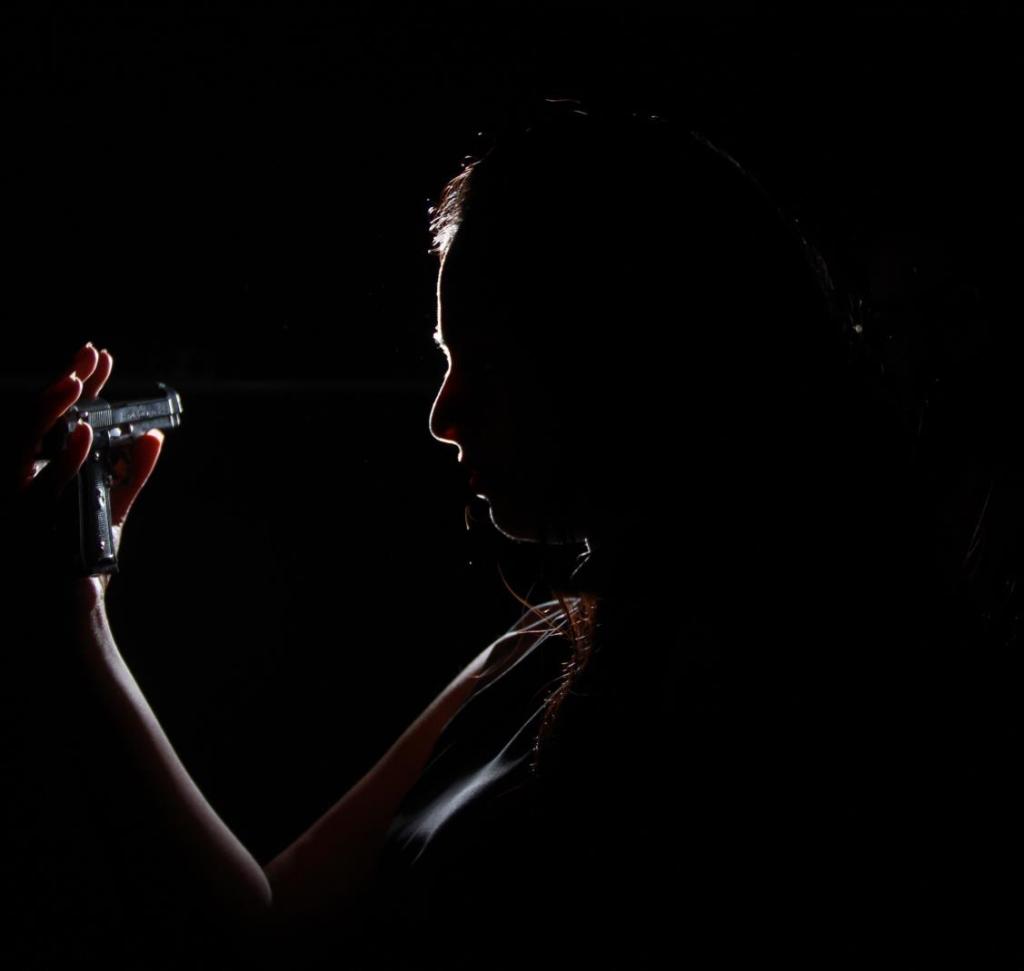
The confrontation is over. The duality is over. What this frame holds is what comes after both, a woman alone in the dark with something she has made completely hers, holding it the way you hold the only thing left in a room. Not as a weapon. Not as a symbol. Just as the thing that stayed. The rim light does not illuminate her. It traces her, a thin line of forehead, nose, lips, chin, the cold edge of the gun, and then nothing. She has not been erased by what she carried. She has been defined by it, so fully and for so long that there is no version of her left that exists without it. The light finds the gun as readily as it finds her face because to the light they are the same surface now. That is where nine shots of loss of innocence finally arrive. Not at violence, not at transformation, but at this quiet, irreversible intimacy between a person and the weight she chose to keep. The void behind her is not absence. It is everything she absorbed along the way, worn so deep inside her that it stopped casting shadows.
Act Three does not give you a fall. It gives you the stillness after the fall has already happened and been accepted and been lived in long enough to feel normal. The toy and the metal gun, the duality and the confrontation, the fluency and finally the dark, these are not stages of corruption. They are the stages of fitting in, which is the quieter and more honest name for the same thing. What the final frame leaves you with is not tragedy in the dramatic sense. It is tragedy in the truest sense: a person who arrived somewhere real, at real cost, and has nowhere left to go from it.
Final Reflection: The Architecture of Silence
The journey from the Sistine Chapel’s divine reach to the isolated rim-light of the void is not a narrative of sudden rupture, but one of incremental “fluency”. As this essay has argued, the loss of innocence is not a theft; it is an education: a slow, administered disappearance of one world to make room for another. We often mistake this process for the natural order of “growing up,” a convenient label that allows us to overlook the “tender conspiracy” of cultural normalcy that dictates what a child is supposed to become. By the time the final panel arrives, the girl has not just survived a transition; she has absorbed a system so thoroughly that she no longer notices the weight of the language she is speaking.
The “toy” served as the essential alibi for this transformation. It allowed the world to introduce the “grammar” of violence under the guise of a gift, training the hands in the posture of acceptance long before the stakes of the “real thing” arrived. This is the tragedy of ludus, the rule-bound play where the structures of adult culture are rehearsed until they are experienced as freedom. The girl’s smile in the presence of Titian’s Eve was not an indicator of safety, but of a “mid-fall” state where desire moves through the body before knowledge has the chance to name the danger. Crucially, the “Correction” revealed that this education is never administered from the outside by a recognizable villain. It is passed down through hands that belong to her own world: faceless, anonymous forces of structure and tradition that operate with the “violence of the ordinary”. Like Fra Angelico’s anonymous tormentors, these influences are impossible to confront because they are embedded in the very textures of daily love and repetition.
The final image, “The Dark Halo”, leaves us with a subject who has reached a state of “irreversible intimacy” with her burden. She is no longer defined by the murals of history or the expectations of the room, but by the “stasis” of what she has chosen to keep. The void behind her is not an absence, but the collective weight of every lesson she has fully internalized. Playtime is over, not because the game ended, but because the girl has become the game. She stands alone in the dark, a person who arrived somewhere real at a real cost, having finally forgotten what the beginning even felt like.
Works Cited
Caillois, Roger. Man, Play and Games. Translated by Meyer Barash, University of Illinois Press, 2001.
Huizinga, Johan. Homo Ludens: A Study of the Play-Element in Culture. Beacon Press, 1955.


Very deep and beautiful depiction of an extremely sensitive transition of a girl child. Kudos Ankit Singh! Hope to have more visual treats from you.
LikeLike