

Editor’s Note: This is the first time a creative non-fiction is being published in the translation section. The original is in Bangla and to make sure that readers get to read to the translation first, the English version is arranged before the original one. Interested readers can scroll down to read the original text as well.
Who knew that the incandescent light you see in the sea at night is kindled by phosphorus?
Maybe many people did, but I didn’t. It’s been a while since I went to the sea—the last time being five years back. This time, when they want to go to a beach after a daylong hangout, I’m pretty reluctant to join them. Not just because my eyes have grown bleary but also because I can’t toss out the inertia heaped inside my backpack.
After a sumptuous meal at a seafood restaurant, I only look forward to returning to our Airbnb. The sun of the Sunshine State has already dimmed down into the horizon. All at once, darkness has nestled into various pockets of our eye-shots. Meanwhile, uncharted melancholia sneaks in through the chilly air of December, which is on its last legs, like a discreet spy.
At this point, Shoishob and Arif jerk the car to an abrupt halt in the parking lot. Then, in two minutes, they cross to the other side of a small wall and set off for the sea, leaving Mouli and myself gape-mouthed. They return only after ten minutes as if to make a loud declaration—' If you guys don't go, you will miss it, big times…and don't ever blame us that we did not ask you to come along.'
Dithering between a 'yes' and 'no,' we get out of the car, leaving Ehan and Arham behind. As the whooping roar of the waves crashes into our ears, we make our way to the beach. I cross the wall following our companions' footsteps, but Mouli makes a light-footed detour instead. Leaving the stagnant city lights behind, we approach the water soaked in the hazy hue of the evening. I can feel my head becoming feathery light and the fatigue of my body wearing thin. All at once, I see a sliver of thunder-light at a distance. What is that? I ask myself, edging forward. The strange distant call of the sea with its resounding emptiness reminds me that it has been a long-time dream of mine to take a ceremonious walk to the solemn waves of the ocean on such a momentous evening.
The truth is I have never had this dream before. Yet, the dream feels so familiar that it looks like I’ve visited the sea many times before. As if responding to the soft call of the clouds, as dark as night itself, I tore out of myself and fetched up at the sea in the silence of the night. That may be why everything seems so familiar as I look around, like the back of my hands. They are parts of my cabinet of curiosities. I let my inner self ride onto the fathomless expanse of the sea and breathe out an all-time favourite tune of mine-
'In the breeze of the shore, in the breeze, in the breeze…'
At my end, the electricity of the phosphorus frolics on the apex of the waves like an ominous danger signal against the vast swathe of the landscape. The sea looks like a magic lantern now, and it feels like Aladin's genie will swirl out of its infinite depths anytime to fulfil our three wishes.
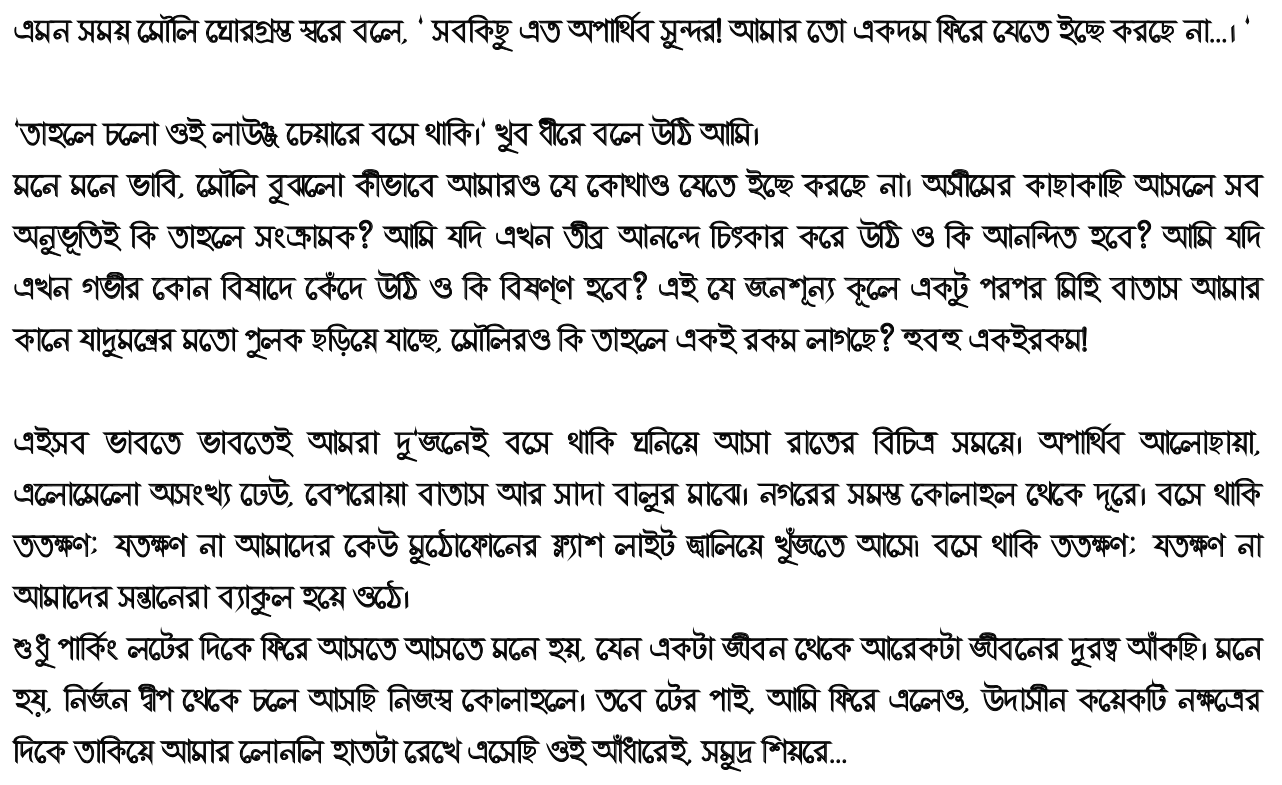
I hear Mouli's voice, spellbound, with the sea breeze ripping through it –
'Why is everything so spectacularly beautiful? I do not feel like going back.'
'Let's sit on the beach chairs, then.', I suggest unhurriedly.
How could Mouli read my mind that I do not feel like going back, either? Are our feelings flowing in tandem as they have come into contact with the infinite? If I erupt into a scream of joy now, will Mouli feel ecstatic, too? Or, let's say, will she share my woe if I break into a sob of pain? Will Mouli feel the same tremor that the breath of wind caresses me with while whispering the symphony of the ethereal bliss into my ear?
Letting ourselves be overtaken by such thoughts, we sit motionless through the tranquil mosaic of the slowly creeping night, surrounded by a flicker of celestial light & shadow and countless fitful waves amid the reckless, defiant wind. We are far away from all the din and bustle of the city.
We stay put until someone comes looking for us with the flashlight of their cell phone, and our children grow restless with their impatient waiting for our return.
As we return to the parking lot, it feels like we are mapping the distance between the two lives bestowed upon us—as if we are returning from the life of a quiet, secluded island to that of quotidien commotions. That said, on my way, as I look up to the cold and distant stars, I can feel, deep down, that I left my lonely hand behind on the dark shore of the sea.


 DoubleSpeak