

Mrinalinee’s Note: This is an excerpt of a proposed book that took shape when I tried consolidating my musings on wilderness in cities as I experienced it for almost three decades on a small hill complex (Tekdi) in Pune. The vanishing Wilderness is not a new story. What interested me was what happens to humans in this process. As we tame wilderness, do we gradually tame ourselves too? I believe, witnessing Wilderness that remains in pockets is the reason why we still see hope in ourselves too. The present writing is an ode to this wilderness within and outside of our minds. Radhika and I have enjoyed walks together on the Tekdi a few times. She connects with the landscape as well as she connects with the words. I knew whom to ask when I wanted to get this translated. What I did not know was how she would make it her own! I couldn’t have asked for more. Let the words now reach the hearts that nurture the wilderness. Let the wilderness prevail!

A pure conscience creates its own uninhabited land,
I pluck a chrysanthemum from the Eastern hedge
and look at the winter landscape stretching into the distance
How fresh is the evening breeze coming from the mountains
Birds return home in pairs
All of this contains deep meaning
but when I try to explain it, words suddenly fail me.
~ Tao Qian
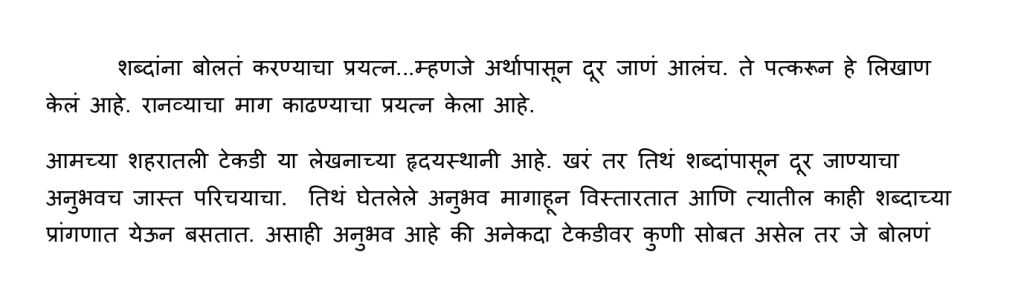
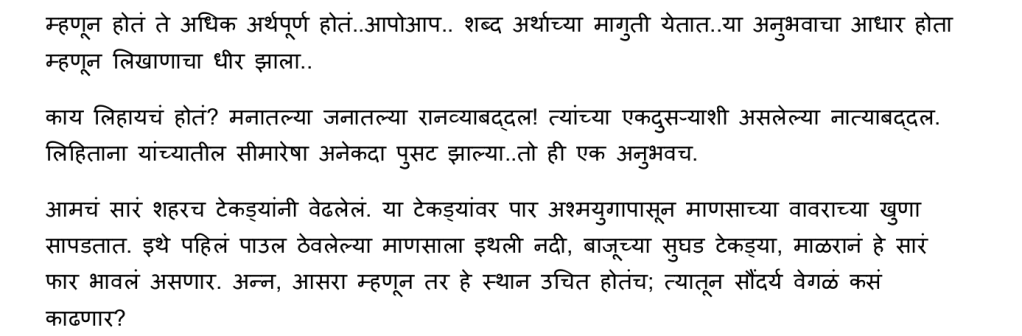


Trying to capture something in words means going away from meaning. I’ve written this with that acceptance. I’ve tried to trace the path of Wilderness. The Tekdi (hills) of our city is at the core of this piece of writing. Though in reality, I usually move away from words when I’m there. My experiences there have magnified over time and only a few of them agree to arrange themselves into words. I’ve found that if someone walks with me to the Tekdi, our conversations there are inevitably deeper… words flow in pursuit of meaning. It’s only because of those experiences that I dared to write this.
What did I want to write? About Wilderness – in the mind, outside the mind and the relationship between them. The boundaries between them turned hazy while writing, which was also an experience.
Our city (Pune) is completely surrounded by hills. Signs of human habitation here can be traced far back to the Stone Age. The first human who set foot here must have been rather pleased, seeing the river, the neat little hills and meadows around here. This must have been an ideal place for food and shelter and can beauty ever be detached from that? In a survey about art, it was found that people all over the world preferred paintings depicting water bodies like rivers, streams, lakes, the open landscape around them and some kind of forested, mountain ranges. If you think about the kinds of photos you’ve seen in a clinic or a hospital, you’ll recall children, flowers and landscapes in them. The roots of this go back to the history of human survival. Each of us might have our individual preferences, but we do share a common, human legacy.
This is not an account of the how and the what of all that has changed since the Stone Ages, or of what went wrong and how we need to go about repairing it. There are a number of books, articles and material available on all that. This is an attempt to express Wilderness in word images – the Wilderness that has wandered into my mind from the grasses, trails and small water bodies on these hills that I’ve been returning to, for the last twenty-five years.
I began to understand that as Wilderness disappears, humans too, become more and more domesticated. These aren’t distinct phenomena. One connects to free verse much better, while gazing at Wilderness in the mountains. And that’s where this piece of writing emerges. Not everything will be captured. But in a rapidly changing world, here are a few stretched out moments in the company of Wilderness, of the mind and outside of it.
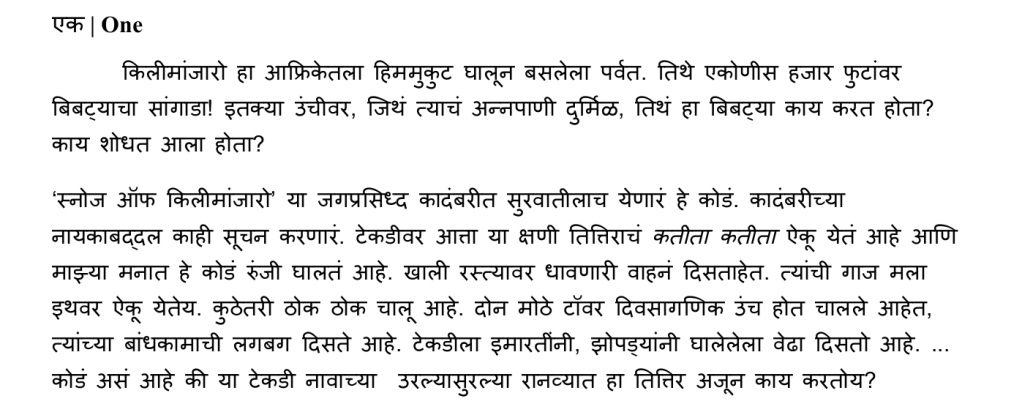
Kilimanjaro, the mountain peak in Africa, wears a crown of snow. There, at 19,000 feet, they found a leopard skeleton! What was this leopard doing at such a height, where food and water is scarce? What was he looking for?
This is the riddle posed right at the beginning of the famous novel, ‘Snows of Kilimanjaro’ that indicates something about the protagonist. In this moment on the hills, I can hear the ‘kateeta, kateeta’ sound of the partridge and this riddle flutters through my mind. I can see the vehicles swarming on the road below. I can hear the roar of traffic even up here. Somewhere, construction is underway. Two large towers grow taller with every passing day. The bustle around their construction site is visible. The stranglehold of buildings and slums around the hills can be seen. Now the riddle goes like this: What is the partridge still doing here, in the vestiges of the Wilderness, called Tekdi?

I encounter such riddles only on the Tekdi. There’s a temple dedicated to Vetaal (jungle ghost) here. Vetaal is known to come and wrap himself around your neck and you must answer the questions he poses. If you know the answer but withhold it, he will haunt you forever.
The barking deer had leapt off this spot here. Right in front of me! Winter was on its way out. The Gliricidia trees had shed their leaves and turned pink. The barking deer couldn’t hide amongst them anymore. He disappeared almost as soon as he appeared. I haven’t seen him around lately. Where did the barking deer go? One of Vetaal’s questions.

As I assemble an answer, a rat snake, brown and black, slithers across. Here, on this path, she has the right of way. I stand respectfully to the side. She disappears quietly into the undergrowth. “She must be there still!” I kept saying every time I passed by, even though I never saw her again. I did see her discarded skin a couple of times that disintegrated into pieces and wafted away with the wind. Will she still be in the undergrowth? The fallen leaves hide pieces of Vetaal’s questions.

Chased by a stray dog, the hare had run like the wind to save its life. The dog ran for a meal and the hare? For its hare-sized life. The hare belongs to the Wilderness. The dog doesn’t live there, though he was a stray dog. Helpless domestication’s deadly pursuit of the Wild. The hare disappears in the blink of an eye, and so does the Wilderness.

Thousands of years ago, the ancestors must have walked this same trail. They must have sat on the same rocks and gazed at the surroundings. They must have sharpened small stones and fashioned them into spears and arrows. This is not just imagination. Their small, stone tools have actually been found in these parts.
A hare would have fed their hunger… a fire would have been lit.
Even today, at times, I trip over hare traps laid around here. The mind wanders into the past. It tries to peek into the future…
Thousands of years ago, would someone have wondered how things would be after thousands of years?
How will the world be after thousands of years?

A perfectly sensible looking man once said to me, “Every tree you see today must have been planted by someone, right? How else could it have grown?”
I was rendered utterly speechless by his question. It was his belief that from the mountain tops to the seashore, nothing could have grown without human intervention. He was walking around with the misplaced gratitude, thinking that all the trees around us were gifts from our ancestors. That day, I just ignored his absurd question. But when I see the dry broom-like Gliricidia on the hill, I can’t help but think of this man and his question. Can you really blame someone who has grown up calling this a ‘forest’? Of course, he believes that every tree has been ‘planted’ by someone!
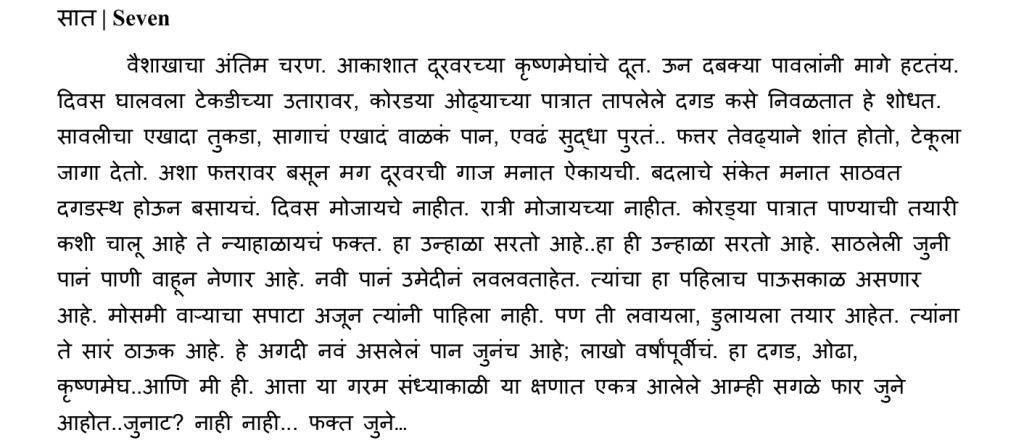
It’s the fag end of Vaishakh. The sky holds messages of rain-bearing clouds. The sunlight recedes with muffled footsteps. I spend the day on the hill slopes observing how the heated stones in the dried stream cool down. Just a piece of shade, or a dried leaf of teak is enough… The stone calms down and creates a resting spot. I sit on such a stone and listen to the distant roar with my mind. I collect signs of change in my mind and sit still, like a stone. I don’t count the days. I don’t count the nights. I only observe how the dry stream is getting ready for water. The summer is passing by… Even this summer is passing by. The water is going to take away the old, dry leaves. New leaves tremble with hope. This will be their first rainy season. They haven’t yet experienced the power of the monsoon winds. But they are ready to bow and dance. They know it all. Even this new leaf is old, lakhs of years old. This stone, this stream, the black clouds… and even I. All of us, together in this moment, on this warm evening are all very old… Old fashioned? No, no… just old.
There are many small, stone bunds on the streams. They look like stitches on an open wound. But can they heal the stream? Sometimes, I meet the Bhutya tree (Sterculia urens) on the banks of the stream. No one understands the stream better than him. Caterpillars of sailor butterflies munch hungrily on his leaves. When there’s a bit of moisture left on the banks of the brook running at his feet, butterflies come to suck nectar from the wet earth. They sit there, wings spread out, merrily basking in the sun.
pecial thanks to the Cosmos flowers! They taught me a big lesson about perception and reality… what is there and what we see! Towards the end of the rainy season, when they paint the hills orange, I feel heartened. I dance with the orange waves. But now I have another lens. Their spectacle is a deception. This invasive foreign flower has slowly colonised land that belongs to indigenous grass and wildflowers. We find garish, large, and symmetrical flowers attractive. But once we see reality, the dilemma begins. People who take such dilemmas to heart take us a little closer to the truth.
Wasn’t Darwin stumped by the peacock? He felt literally nauseous when he saw the peacock’s plumage. Who doesn’t find the peacock beautiful? If they sight one, even strangers happily point him out to each other. The peacock becomes a link for those otherwise lost in their own ‘zones’. Even I watch the peacock. Gladdened. But now, Darwin also lives in my head. He had asked, “What is the utility of the peacock’s fan?” The poor thing finds walking difficult with that huge trail. He can hardly fly. Easy prey, glaringly visible to predators. Then why have this fan? Just for the female to see the risk he takes? Higher the risk, higher the probability of finding a mate. A fan for the propagation of the species. The peacock pays a price when he dances. Knowing this makes us see the peacock differently.
Here the dilemma is, should one stand transfixed by the cosmos flowers, walk away from them or actually destroy them? Between the speed of my footsteps and that of seed dispersal… who will win?

Amidst the crowd of Gliricidia and Subabul (River tamarind), there are trees that couldn’t have been planted there, indicating the presence of a living, breathing Wilderness, a piece of the wild that I stand and watch, mesmerised. If someone is with me, I feel like showing it to them excitedly. “You know, this is Bartondi (Indian Mulberry) and she’s not ‘planted’. Look how green she is even in summer! She’s an original inhabitant of this area and grew here on her own.” It’s not that these shows of mine elicit no sympathy. But still my heart is drawn to this resilient Bartondi. What must a tree living as a vestige of an ancient canopy feel?
One such Bartondi can also be seen on the road of the settlement at the foot of the hill. She seems to have settled for a life there. Is this the end? A lone Bartondi, with no friends to converse with… how long can she hold on?

It’s only quite recently that humans have begun understanding that a tree doesn’t exist alone. Even seeing a table without a chair makes us feel like something is amiss. Trees too need real, living companionship. We can now hear and see their exchanges. We can try to understand the conversations of the Wilderness. One of the conveyors of these conversations are fungi. But for the fungi, who will decompose the fallen leaves in the forest? Who will help the trees absorb water and nutrients? To say the least. Only now, are we able to start hearing this conversation of the Wilderness. We are trying really hard to listen to it but there will be many things that will remain beyond the powers of our hearing. We’ve either been destroying the Wilderness or planting trees based on our (limited) understanding. To let the Wilderness have enough space for its conversations is a distant dream for us, quite distant.

I see burnt earth on the hill. How will fungi take hold and grow on it? We will only be able to see whatever can manage to grow without it. Our future generations will grow up thinking of that as Wilderness. Conversations will keep getting lost.

On my familiar path, when the Sonsawari (yellow silk cotton tree) trees shed their year-long fatigue and stand proudly donning their Son (yellow silk cotton) flowers, I stare at them with wide-eyed wonder. When I see these trees, I feel like I’ve suddenly remembered an old-world word – like ‘carafe’ or ‘casket’, despite living in our ‘LOL’ cellphone language world. You can find the Sonsawar only on the Tekdi top. Nowhere else in the city. Ms. Sonsawari, I can’t perceive how tall you are. How are you still standing here? You’re the only one in the whole forest, standing and spreading your large, rose-like, bright yellow flowers. You’re like a flash of gold in the midst of a crowd of dull, faded pink Gliricidia. Why does seeing you make me feel suddenly consoled? You still contain a whiff of wilderness. My hunger for conversation is satisfied just a bit. I can see that you long for conversation too. Your family grows a little bit, every year, doesn’t it? Otherwise, how can I see your children and grandchildren growing on the same island? All of you bloom together and we onlookers watch spellbound. There are many who are smitten by your cousins – the Palash (Flame of the forest) and Pangara (Indian Coral tree). Poets and nature lovers, even more so. But they seem to have slowly withdrawn (their favour) from the Tekdi. You might find a lone Pangara shedding its orange-red flowers somewhere. But it is you who actually invites the birds and the bees. Who knows what else these winged beings will bring along with them? What will they sow? I long to see all this unfold slowly.
But there is a limitation to these limitless longings of mine, O Sonsawari! Human life is rather short. There is a lot of room now to speculate about my digital immortality. But how close is that going to be to the existence, the experience that my five senses know? I don’t know. What I know are certain stories of long-living trees. They say there is a 1500-year-old Spruce tree in Sweden. That’s roughly 115 times a human life span. Ask that tree what time is. What is hurry and what is leisure for it? What has this tree done to stay alive for so many years? Rebirth through branches, through roots… It’s an amazing story. Perhaps, we can never find what can be called the original tree, but how do we separate the new from what was the original? Riddles all…
Far out in the Sahara desert stood the loneliest tree of the forest. An acacia. It seems we’ve named it the World’s Loneliest tree. What is this viewpoint we’ve evolved! Why do we seek out and find who is lonely and who isn’t? Be that as it may, this tree has been identified as ‘lonely.’ It was the only tree on a 400 km long travellers route. It still stands, but now it is one that has grown out of one of the original branches. The original tree was supposedly struck down by a drunk truck driver in 1973! The tree grew next to a well there. It was the only tree on the never-ending, terrifying road through the desert. How hadn’t camels over the centuries eaten up all its leaves? How didn’t its branches end up in bonfires? The answer is that over time, this tree didn’t remain a tree at all, but became a lighthouse. A shrine for wayfarers, something they could rely on while navigating through the desert. Apparently, travellers gathered around the tree and prayed for a safe journey.
How would these conversations sound to the tree? And when would it feel like we hear the conversation in its mind? Questions all…
After every monsoon, when the planted and unplanted trees shed their leaf-loads, the horizon looks changed. The buildings come closer. And an image of the future ten, twenty, fifty years hence, begins to taunt the mind, as though the distance between the two worlds has begun reducing rapidly. Where will the Sonsawari tree feature in this image? Will she feature at all? The golden light shed by your flowers in the mind begins to darken like this… The shadows have also lengthened now. It’s time to go home… for me, for the birds…

Even my trail is blackened with ash. The golden glow of the Son flowers looks even more stark against it. The funny thing is, the Gliricidia has begun shedding its new leaves on this ash. Slowly, the wounds of the ash will heal, new conversations will begin… How can one say who is conversing or how fresh or how old these conversations are? But the feeble pulse of the conversation is still visible. And in the darkness, the Sonsawari is slowly taking her jewels off her bare body too. The month of Chaitra (spring) will make a new saree for her too. She will spread it and will stand like a touch-me-not tree for the rest of year. She’ll meet us next autumn dressed in all her glory again…
This is my conversation with some wild flowers on the hill, on an end-of-winter evening. This is my goodbye… Eighteen
What is it that dwelleth here
I know not
But my hear is full of awe
And the tears trickle down
– 11th Century, Japanese poem
I meet a man on the Tekdi. He takes out a small bag from his sack and strews wet waste around the roots of a tree. From the same place, he collects some sticks and twigs for his stove, which will cook his rice. That’s all the exchange really is! If this give and take is possible, the wilderness will bless us.
Vetaal has got his answer. Now silence is desired.
 DoubleSpeak