

Nilam Devi crouches on her haunches on the mud floor of her kitchen, her bright blue polyester sari bunched between her sweaty thighs, and the skin between her blouse and her sari's waistband beaded with sweat. The red glass bangles on her wrists clink, chaan-chaan, as her hands, holding the batta—a cylindrical hand-held roller made of basalt—move with the quiet authority of grr-grr sounds over the flat stone of her sil. Her gestures are steady and deliberate, creating a slow rhythm of repetition and memory, chaan-chaan, grr-grr, a duet between hand and stone, an act perfected by generations of women before her.
With a knowing press of her palms against the stone batta, her eyes narrowed, she transforms fresh coriander, mint leaves, chillies, and tamarind into a smooth blend: a tangy green chutney. She studies the texture, knowing that she is not so much checking as crafting. Holding a wedge of half a lemon between her thumb and index finger, she squeezes its juice, adds some salt, and gently moves the batta over the chutney for a few more seconds before scooping the green, squishy mixture into a steel bowl. The scoop is an art in itself. Today, she prefers the three-finger sweep to her single-finger curl. She places the chutney bowl beside the dal, chawal, alu chokha, and papads she has made for lunch.
Nilam Devi knows, as all women of Bagla village in Samastipur district of Bihar do, and women who have lived before them here do, that silbattas don't just grind. They press, smear, coax, and persuade each ingredient they grind to give up their flavour, aroma, and texture, so that, together with the other ingredients they have combined with, they emerge richer, tastier, and healthier, preserving and enhancing each other's heating, cooling, and medicinal qualities. She thinks of how easy it is for these ingredients. like women, to lose their individuality, their distinct tastes, shapes, and colours.
Nilam Devi knows, like all the women in Bagla village in Samastipur district of Bihar, that silbattas can never be purchased. These stone grinders are family heirlooms—living traditions passed down from mothers as part of a dowry. They symbolise the promise that their daughters will help shape the kitchens they enter. Alternatively, silbattas may be given by mothers-in-law when daughters-in-law move into their new homes, carrying the hope that they will continue the family's cooking traditions. Nilam also knows, as all other women, that silbattas are to be stationary. Because of their weight, they are to be near a window where light can reach them and close to a water source for washing after being scrubbed with ash from the traditional mud challah (stove). Furthermore, she is aware that although modern machines can mix ingredients in seconds, no one will bring them home because of the lack of electricity and men's belief that food prepared by machines tastes terrible.
Nilam Devi knows, as all women of Bagla village in Samastipur district of Bihar do, that silbattas speak, if you know how to listen; they hum when content, resist when misused. She also knows, as all women have, now and before, that silbattas, in turn, listen when you speak with your hands: a light roll and it will produce a smooth paste; a sharp push and it will grate the ingredients into a coarser mix. And she also knows, as women of all ages do, that silbattas have their moods too, just like women. That they will only be happy, sing even, if they have the right balance on the floor, the right incline to drain liquids, the right friction and the correct pressure—or else sulk.
This morning, Nilam Devi ensured that the lentils, rice, potatoes, and fried snacks are to her husband's preferred consistency and taste. Carefully, she has stoked the fire in her mud stove with a narrow iron tube, rearranging the twigs and cow dung to achieve the right heat for the desired thickness, all while enduring a cough from the smoke. She has made extra food for the guest arriving for lunch with her husband; she does not know who it is, as he did not reply when she asked. Her early morning has involved kneading pliable cow dung by hand, shaping it into round patties with dried grass, and sun-drying them on a designated wall. Later in the evening, she will collect the hardened cow dung pats, which have dried under the scorching June sun, and store them among the many layers already stacked in a thatched hut. In addition, she has cleaned and mopped the entire house, swept the cobwebs off arches above the central courtyard, washed clothes, fed her bedridden mother-in-law rice khichri (porridge that dribbled down her chin), plucked potatoes from the ground, tended her garden herb patch, fed her three children, two boys aged five and eight, and a girl aged ten, and readied them for school, bathed herself, prayed at the local temple, and tinkled her puja bell at home and her own gods with holy water from the temple.
Nilam Devi hears approaching voices; her husband's loud tone and a woman's chiming laughter. She quickly pulls her pallu over her head. The woman has her hair loose and is wearing a sleeveless, light purplish salwar kameez, with a plunging neckline, lipstick, a bindi, and bangles. earrings and slippers of the same colour; a golden nose pin strobes on the left side of her nose. Nilam Devi gapes at her, shocked by her attire and by the familiarity she shows towards her husband, Avdhesh Yadav, calling him by name. She looks askance at her husband.
He ignores her and, instead, says, "Ma, dekko kaun hain." (Ma, see who is here.) "Maya, humari puraani padosi aayi hain" (Maya, our old neighbour is here.)
"Yaad hain main use saath khela karta tha? Woh log Patna chale gaye the aur wahin se woh ab apni bua ke pass aayi hain. Main use aap ko milne le aaya." (Remember, we used to play together? Her family had moved away to Patna, and she is back visiting her aunt. I have brought her here so she can spend time with you).
There is no answer from his mother.
Looking at her, finally, he says, "Khana paroso, Maya yehin rahegi kuch dino ke liye." (Serve food, Maya will stay here for a few days).
She notices how quickly his gaze shifts to Maya, how it lingers on her body, his eyes lustful, and she realises that he has never looked at her in that manner. Never! He has never called her Nilam either. He has, in fact, never addressed her by name, full or otherwise.
"Why is Maya staying here when she has an aunt in the village?" Nilam Devi wonders. "Is the chameli tel (jasmine oil) I smell on her the same that wafted out of my husband's kurta?" she asks herself. "And, here, I stupidly believed it to be some aroma from the mithai (confectionery) shop that he owns." She shakes her head as if to shake way the thoughts as well.
Nilam Devi gestures for Maya to follow her into the dining room, then points to the mat on the floor.
"Don't you have a dining table?" Maya asks, dismay in her eyes.
Avdhesh is quick to respond. "Aap haath do lo, main chota katiya le aata hoon. Hum wahin batenge." (Wash your hands, I will pull up a small cot, and we can sit on it with our lunch plates.)
He has never made any such effort for me, Nilam Devi thinks to herself, nor has he ever asked me to join him for a meal. Maya eats with gusto, relishing every mouthful, but her husband merely grunts. "Make pakoras for tea," Avdhesh orders before he retires to his room. Both watch his retreat.
Maya stays behind but does not offer to clean up. She sits on the cot while Nilima Devi eats her meal alone. As Maya looks around the kitchen, her gaze falls on the haat-wali-chaaki, the stone grain grinder used to turn grain into powder. Her face expresses disbelief.
"Don't you have a gas stove, a blender, or a fridge?" she asks.
Nilima Devi shakes her head in response.
"How did you make the chutney?" Maya inquires.
Nilima Devi gestures toward the silbatta, which sits silently, gleaming from a recent wash.
"Do you not have help in the kitchen either?" Maya continues.
"I used to have a young girl named Radha, but she passed away," Nilima Devi replies, speaking to Maya for the first time. "In fact, I was just thinking of her when I saw your chain."
"My chain?" Maya asks, puzzled. However, her curiosity quickly shifts back to Radha. "How did she die? You said she was young."
"It's a long story," says Nilima Devi.
"Tell me; I have time," Maya urges.
"Let me start with preparations for the pakoras, as the children will be here at three, and I will tell you as I work." Maya nods in agreement.
Nilima Devi takes the soiled utensils out to the courtyard and then returns to the kitchen. She retrieves a steel container of besan (chickpea flour) and gathers onions and green chillies from the wooden shelf beside her. She sits down to slice them.
"These are for the pakoras," she explains.
"You were saying about Radha, didi," prompts Maya.
"Yes, well, Radha was this young girl who used to come daily from the village to help me. She was a devoted girl, fast and adept at chopping vegetables, washing dishes, and mopping. One day, Avdhesh's younger brother came to stay with us, like you, for a few days. He, like my husband, is very spirited, makes friends easily and took a fancy to the girl. You can guess the rest of the story, Maya. Soon, I discovered she was pregnant. Her parents would have burnt her alive if they knew. One day, I overheard her begging my brother-in-law to marry her, but he scoffed at her, saying she was not of his caste and, anyway, he was engaged to someone else. They got into an argument, and she picked up an axe to strike him. He overpowered her, and somehow in the scuffle, the axe pierced her, killing her on the spot."
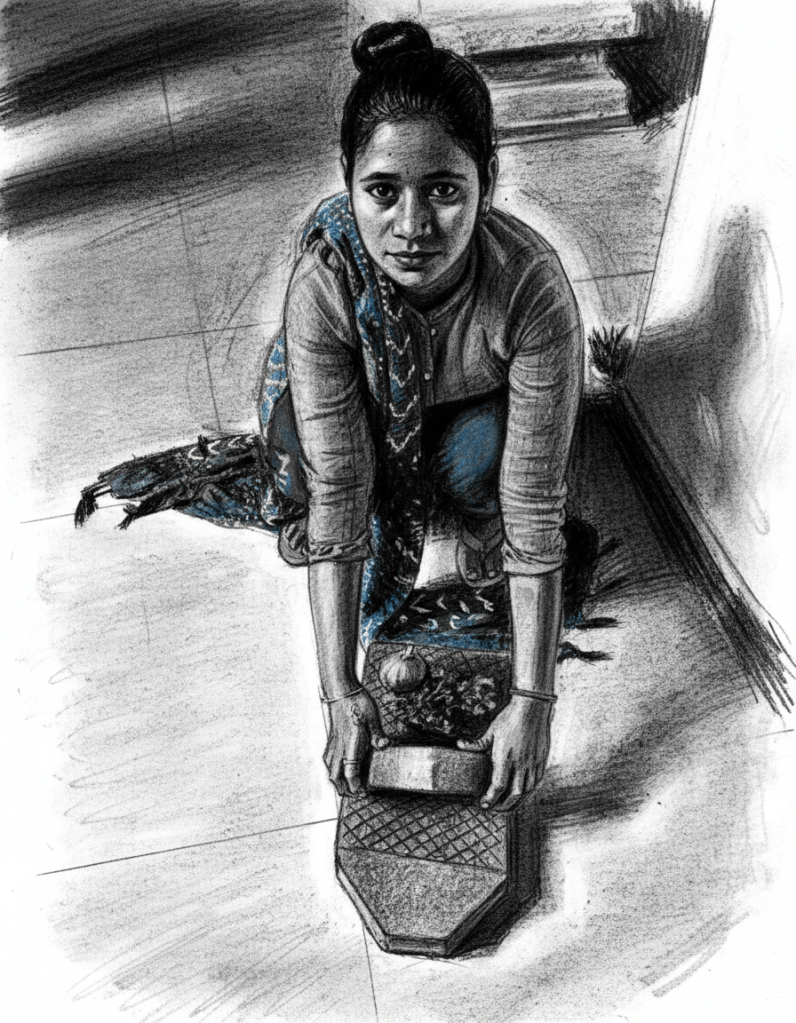
Nilima Devi then proceeds to separate coriander leaves from their stalks, which she has wrapped in a wet muslin cloth, her face calm, as if she had just narrated a fairy tale. She then dices a raw mango, three onions and six green chillies with the swiftness of summer lightning and moves towards the silbatta. She places the coriander leaves, chopped green chillies, onions, and mango, and, using her toned, practised arms, begins to roll the batta on the sil. Maya notices, fascinated, that unlike the blades of the mixie, the batta does not whip the ingredients but gently mows them, with almost a kind of silent gratitude; the leaves retain their potency, the mango its tang, the onions their pungency, while the chillies don't sting but settle into the mixture.
"This is how you press the mango and onions, this is how you know the coriander pulp is ready, this is how you know if the chillies have mixed well, and this is how you know it is time to add a bit of tamarind, before you add salt and squeeze a bit of lemon juice," says Nilima Devi to Maya, a tender smile on her face. "You have to be patient, and you have to keep grinding till it's ready. And no one will know the effort involved, the attention needed, and there will be no applause. For me, it's about faith: the belief that if you move your hands correctly with the batta over the sil, it will yield a beautiful mixture. The experience is quite like my marriage, which is a habit, a rhythm, and a surrender, yet one that cannot afford inattention; one has to be mindful of small details," she adds.
So slow and effortless are her movements that Maya has no way of knowing that Nilima Devi has mixed her anger into the chutney, pressing it deep into the stone along with the other ingredients. The silbatta or rather the sil and the batta are the only witness to this act. Obeying her commands without resistance and choosing to remain silent, their loyalty to Nilima Devi is so unwavering that they decide not to allow the chutney to turn bitter, even though they could rightfully do so.
"What happened to the girl's body?" Maya asks impatiently, worriedly; her voice is brusque like the whirring mixie blades.
"Oh, you know, the brothers dug up my herb garden—where my coriander and mint grow—and buried Radha there. What else could they have done? They couldn't face the wrath of her parents or the villagers; they're not that courageous, Maya. My husband, of course, is a generous man. He gave Radha's parents his brother's gold chain, very similar to the one he owns, saying that we, as a family, grieved for her disappearance just as much as they did."
Maya looks at Nilima Devi, the herb garden, and the silbatta, in turn. Her face is ashen. Dots float before her eyes, smudge by degrees and turn into shadows. She feels a slow but definite growth of something whole within her. Like the mango seed that Nilima has discarded.
Nilima empties the chutney into the bowl and readies the wok for deep-frying the pakoras. "Let me light the fire in the chullah. See how I have already set it up with twigs and cow pats. I need to make sure the pan is really hot before I fry. It leaves me enough time to ready the chickpea batter, and set the saucepan to make chai with water, crushed ginger, elaichi (cardamon), dal cheeni (cinnamon) and sugar."
There is a silence between them.
The pan sizzles with the heat of the oil, sending up wisps of smoke. The saucepan, too, releases ribbons of steam as the water within bubbles. Nilima Devi hastily heaps six measured spoons of tea leaves into it. "Do you think you can blend into this life, like these tea leaves blend into boiling water, if you marry a man in the village?" she queries as she hand-drops dollops of chickpea batter into the oil. They both listen to the hiss, sizzle and sputter of the batter in the oil.
Maya does not answer. Her mind is in a tizzy. Images of Radha…her gold chain…words of flirtation…bursts of anger…fisticuffs…axe…a hole in the ground…a garden with rows of virulent green coriander and mint whirl before her. Is Nilima's story the truth? Or is it a fib, a filtering of facts to suit her purpose? Or is it an audacious fraud, set to deceive her with nefarious intent? She searches Nilima's face, yet again, for clues. She studies her movements for any indications, any sign, or adjustments of any sort. Nilima's face is inscrutable as her silbatta, and her stance is as still as it is. It is almost as if they are one.
The children screech their arrival. It breaks Maya's reverie. "Ma, we can smell pakoras!!" they yell in delight. "Who is this, Ma? Has she come in place of Radha?"
"Shhshh, she is Maya bua, your father's sister," Nilima Devi scolds. "Go, wake up your dadi, your grandmother needs to meet Maya."
Their excitement evaporates with the night air. The next day dawns bright. Nilima Devi is finished with all her duties and adorns her forehead with orange sindoor, the vermilion powder stretching from her eyebrows to her scalp. She sees Maya ready to leave with her suitcase. Her hair is in disarray, her eyes are flamed and puffed, and her clothes are crumpled. She is tugging at a tassel at the edge of her dupatta. "Why are you leaving so soon? What's the matter? You look like you have not slept at all. Won't you say bye to my husband? He is still asleep," Nilima Devi rushes to ask.
Maya says, in a raspy voice, "My aunt has taken ill with sunstroke. I need to leave. My brother has come to fetch me." Her gold chain shimmers as it catches the sunlight.
"Oh no, let me make you and your aunt some aam ki launji, this will help cool down your systems. The mango is already on the boil. I have to just rough grind zeera (cumin), dhania (coriander), saunf (fennel), methi (fenugreek), sarsoon (mustard) and kalonji (nigella) seeds, along with asafoetida, red chillies, garam masala, misri (rock sugar), and kali namak (black salt), and season it at the end with mint and coriander leaves," Nilima Devi says.
"No, no, please don't bother," Maya urges, feeling sick in the stomach just hearing her.
"No, I insist," says Nilima Devi.
Maya hears the low scrape of the batta in the kitchen.
As she moves the batta over the sil, which purrs to her, Nilima Devi decides to write to her school friend, Suresh. It has been a while since she has seen him. Thought of him.
 DoubleSpeak