

It was a relaxing afternoon at the ghats of Banaras, and the Ganga River flowed gracefully, carrying with it the spiritual essence of the ancient city. As I strolled along the riverbank, the rhythmic clinking of utensils caught my attention. Intrigued, I followed the sound and discovered a humble man immersed in the labour-intensive task of washing the utensils used for the daily Ganga Aarti.
The man, clad in worn-out clothes that seemed to have weathered countless washings, stood aside a makeshift platform surrounded by numerous stainless-steel plates, bowls, and cups. The leftover of the previous night's sacred ceremony clung to the vessels, a testament to the spiritual warmth that enveloped Banaras.
His hands, weathered and hardened, moved with a practised precision as he scrubbed away the leftover of the religious offering. The sun was on the peak, but this man was already knee-deep in the task that awaited him each afternoon. His eyes reflected a combination of weariness and determination, as if he had undertaken these ritual countless times, yet approached it with a sense of duty.

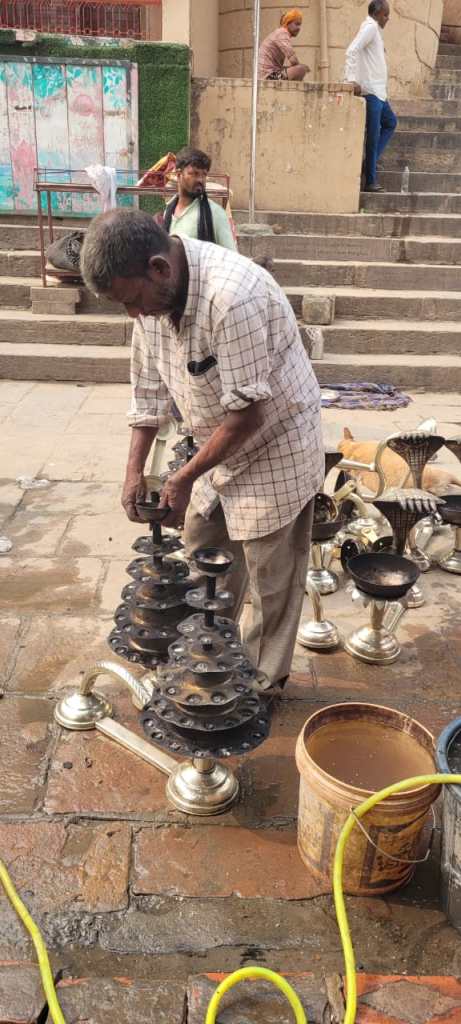

As I observed from a distance, I couldn't help but notice the cheerful attitude that accompanied his diligent work. The man sang melodious tunes, filling the air with a sense of joy that contrasted sharply with the seriousness of his labour. It seemed as though the act of washing the sacred vessels had become a form of meditation for him, an intimate connection with the divine.
Curiosity led me closer, and I struck up a conversation with the man. His name was Ramu, a resident of Banaras who had taken upon himself the responsibility of ensuring the purity of the utensils used in the Ganga Aarti. He spoke with a sense of warmth that invited me to share in the simple pleasure of his daily routine.

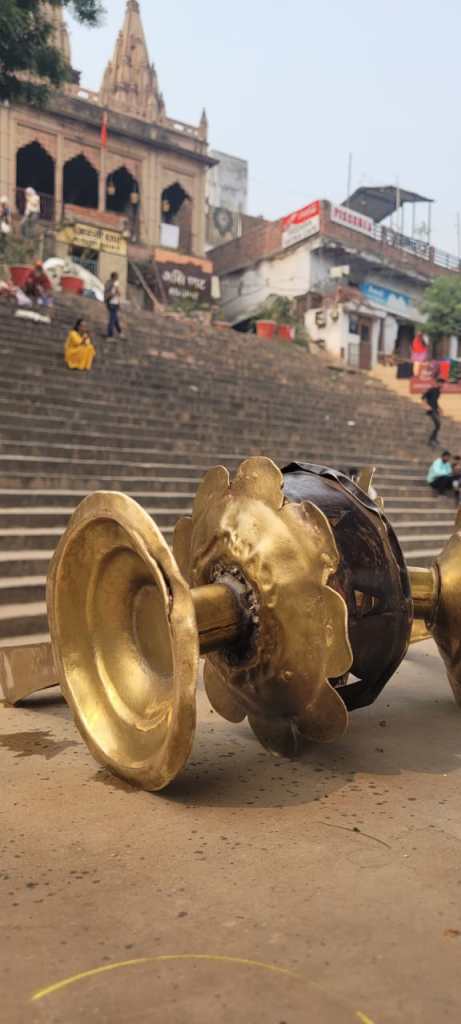

As he scrubbed away at a particularly stubborn stain, he chuckled and shared a political joke that had become somewhat of a ritual during his work. "You see," he said, gesturing toward the vessels, "these plates are like politicians – no matter how much you clean them, there's always some dirt left behind!"
We laughed together; the irony of the metaphor not lost on either of us. The Ganga, a river considered sacred by millions, seemed to mirror the political landscape in its constant ebb and flow, carrying with it the residue of societal complexities.
Ramu's interactions with strangers were not limited to humour; he engaged in spontaneous conversations with passersby, discussing everything from the weather to the latest local gossip. Amidst the clatter of utensils, the ghats of Banaras transformed into a communal space where stories were shared, laughter echoed, and burdens lightened.
However, amidst the friendship and light-hearted gossip, there were moments when Ramu's face betrayed a hint of fatigue. The labour-intensive nature of his work was evident, and as he wrestled with a particularly stubborn stain, I could see beads of sweat forming on his forehead. The physical toll of scrubbing away the leftover of the previous night's rituals became apparent, highlighting the often-overlooked struggles of those who ensure the seamless execution of sacred ceremonies.

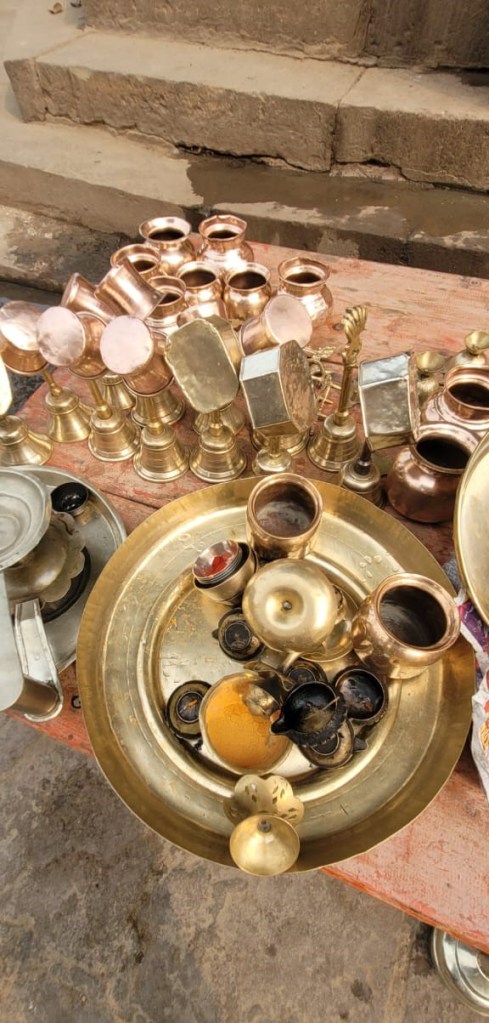

I offered to lend a hand, but Ramu declined with a smile, insisting that he had developed a rhythm that made the task almost meditative. His commitment to his work, despite the challenges, spoke volumes about the resilience embedded in the fabric of Banaras – a city where spirituality and daily life intertwine seamlessly.
Despite facing difficulties in capturing the essence of this labour-intensive process through photographs, I couldn't help but appreciate the dedication that Ramu brought to his humble role. As the noonday sun began its descent, casting a warm, amber glow upon the ghats, the vessels gleamed with newfound radiance, reflecting the lingering purity of the Ganga herself as the evening unfolded.


In the midst of this experience, I found myself learning a profound lesson from Ramu – a lesson that outshines the surface of his daily routine. The satisfaction and happiness derived from diligent work, no matter how humble, were evident in his every gesture. It was a reminder that true contentment is often found in the simplicity of dedicated effort and the pursuit of one's duties.
As I bid farewell to Ramu and the ghats of Banaras, I carried with me not just the memory of a man washing utensils but a deeper understanding of the unseen threads that weave the canvas of spiritual practices in this ancient city. This story is a humble attempt to shed light on one of the countless activities that unfold daily along the sacred Ganga, inviting us to appreciate the diverse and complex canvas of life that defines Banaras.
 DoubleSpeak