

This project initially started out as an attempt to depict workaholism and the sacrifices it calls for, as well as the rewards it gives. However, in the course of this project, I discovered something much more interesting. Most of the people I thought of as ‘workaholics’ were not doing it out of a passion for their work, but were forced into it. The reasons were the same reason anyone goes to work: the all-consuming prison of capitalist society that drives people to always aim higher, grind harder and keep the gears of the industrial machine turning.
This ‘involuntary workaholism’ causes a sense of fatigue, sadness and an inescapable sense of alienation. The purpose of this project became to document this misery and loneliness caused by work. I tried to frame my subjects as either distinct figures cut-off from everything else in the photo, or as dehumanised silhouettes. I tried to shoot in a natural environment without fancy lighting equipment, and have tried to preserve the raw format of the photograph as best I could. The purpose of this was to give the photos a more gritty and raw feeling which I felt was appropriate for the subject matter I was dealing with.
This project took me from library cubicles on campus to the markets of Delhi to the beaches of Chennai. The reason for this variety was partly because I grew bored shooting the same subject very quickly, but also because I wanted to demonstrate the universality of the statement I was trying to make, and how it impacted different people in different ways.

This photo represents the basic thesis of this feature in its least subtle form. A single student separated from the rest, deep in her notes while the rest are talking among themselves and having fun. The black and white further emphasises the draining nature of work.

This photo once again shows the isolation of work. It shows a single vendor surrounded by empty space, waiting for someone to walk past and buy something. The above two photos combined display the loneliness work can cause, not only from your peers but an alienation from everything you know. The final result is a person left working in a barren, deserted landscape.

This photo is meant to capture the fatigue that work causes. The fluorescent light from the laptop illuminates the subject’s tired, dead face. The rest of the frame is dark, as if he’s consumed by the void of academics.
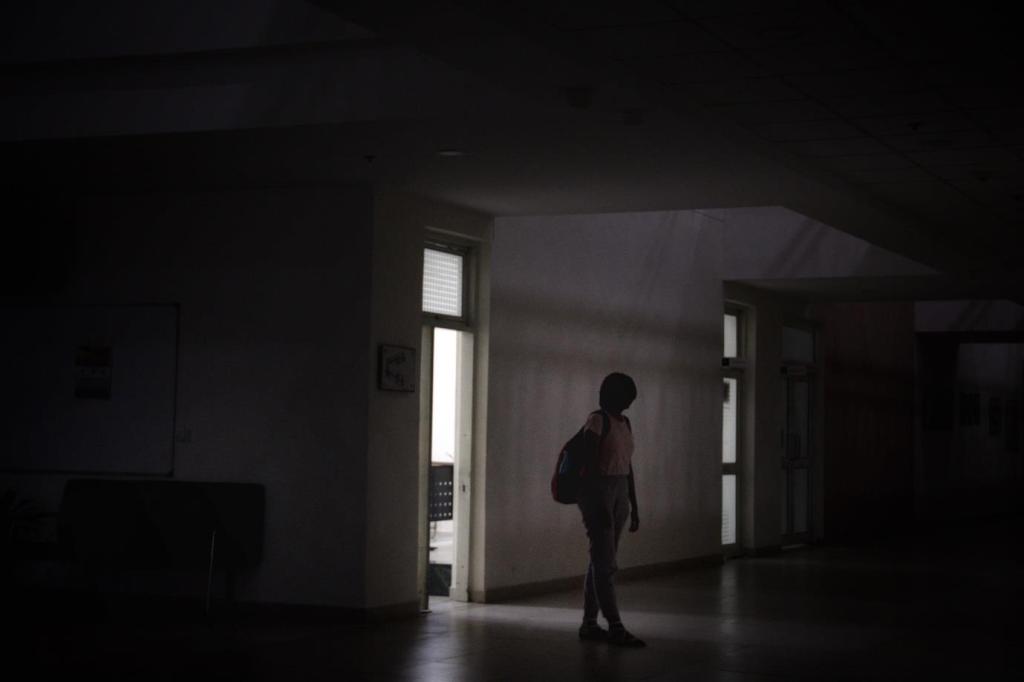
Similar to the previous photo, this one also shows someone working late at night, with very little lighting. The subject is silhouetted to demonstrate the loss of identity caused by work. The late nights leave little time for other hobbies, interests and slowly cause one to lose themselves as their personality is overtaken by their work.

This photo has three distinct elements at varying levels of focus. Closest to the camera and at perfect focus is a pen that lies triumphantly on a set of notes, representing the fruits of labour. Further and slightly out of focus is the second subject, relaxing after a long night of work.
But the rest does not last long, as the third subject, out of focus but always lurking, is once again typing away on his laptop. The cycle goes on and work never stops.

While I initially wanted to photograph a subject in an office space, I later realised it might be more appealing to photograph the office space itself. I wanted to personify the place of work, to show it as an endless, soul-crushing void. The fluorescent lighting contrasts the dark shadows, and the glass doors lead to a black void at the end. For some reason it reminded me of The Matrix, and I punched up the green curves in post to highlight that.
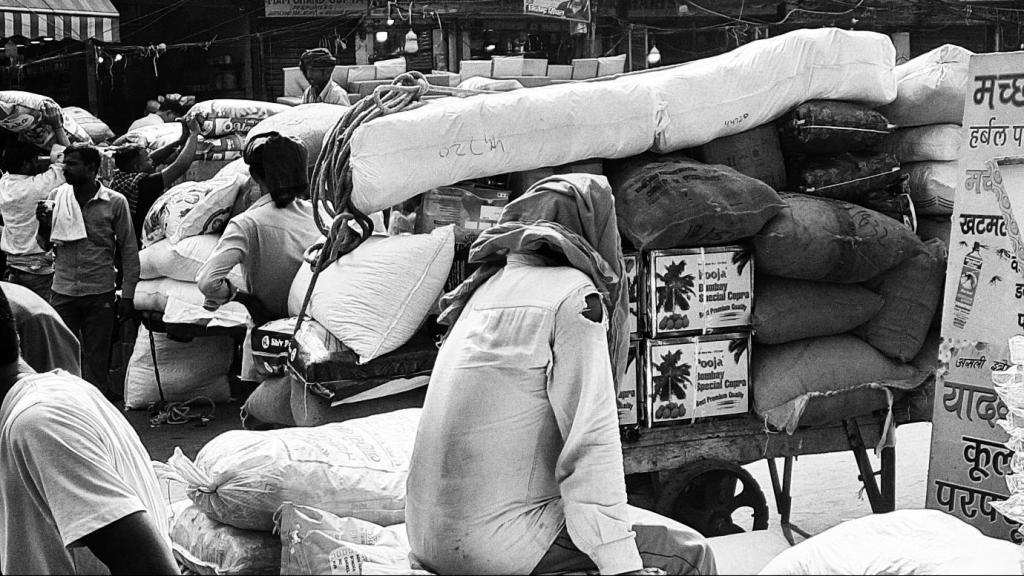
Unlike the previous photos, this photo has multiple subjects in close proximity to each other. But despite the proximity, the subjects are still disconnected. The bustling chaos of the market leaves each person isolated despite being surrounded by other workers. Multiple people move here and there carrying heavy sacks, expertly avoiding each other to get to their destination. An intentional effort has been made to not show any distinct faces in the photo, to highlight the loss of identity caused by work. Each person just becomes a number, to be replaced in an instant. The photo has also been taken in black and white to further highlight the loss of identity.

This photo was taken of metro workers near Marina Beach in Chennai. I used the bars to highlight how the workers were ‘trapped’ in their labour. The context of metro work is also important here, since the metro is mainly something that helps people get to work and back.

This photo, once again taken at Marina Beach, depicts a single fisherman standing among several worn-out boats. The photo was taken towards the end of the beach, where the boats which once provided livelihood for fishermen simply sit collecting dust. It is meant to represent the emptiness of labour, and how our daily efforts add up to nothing but a forgotten boat.

The shed photographed here is a place where police officers relax and try to spot criminals on the beach. While I was taking photos, a man came up to me and advised me not to take photos as the police may cause trouble. I soon got into a conversation with him and told him what I was doing, after which he showed me around other stalls at the beach. I asked him what work he did, and he told me that he used to have a stall but retired. However, after his son died due to COVID, he had no one else to take care of him and had to go back to work, doing off jobs around the beach. The photo here is used to represent this emptiness caused by labour. We work thinking the sacrifices we make will have some reward, but there often is no pot of gold at the end of the rainbow and we are just left with an emptiness, which can only be filled with more work.
In conclusion, this feature has attempted to visually highlight the misery and loneliness that labour causes. Workers are simply exploited to meet a bottom line and are discarded as soon as that end is met. The labourers are left as shadows of who they were, empty and dishevelled.
 DoubleSpeak